

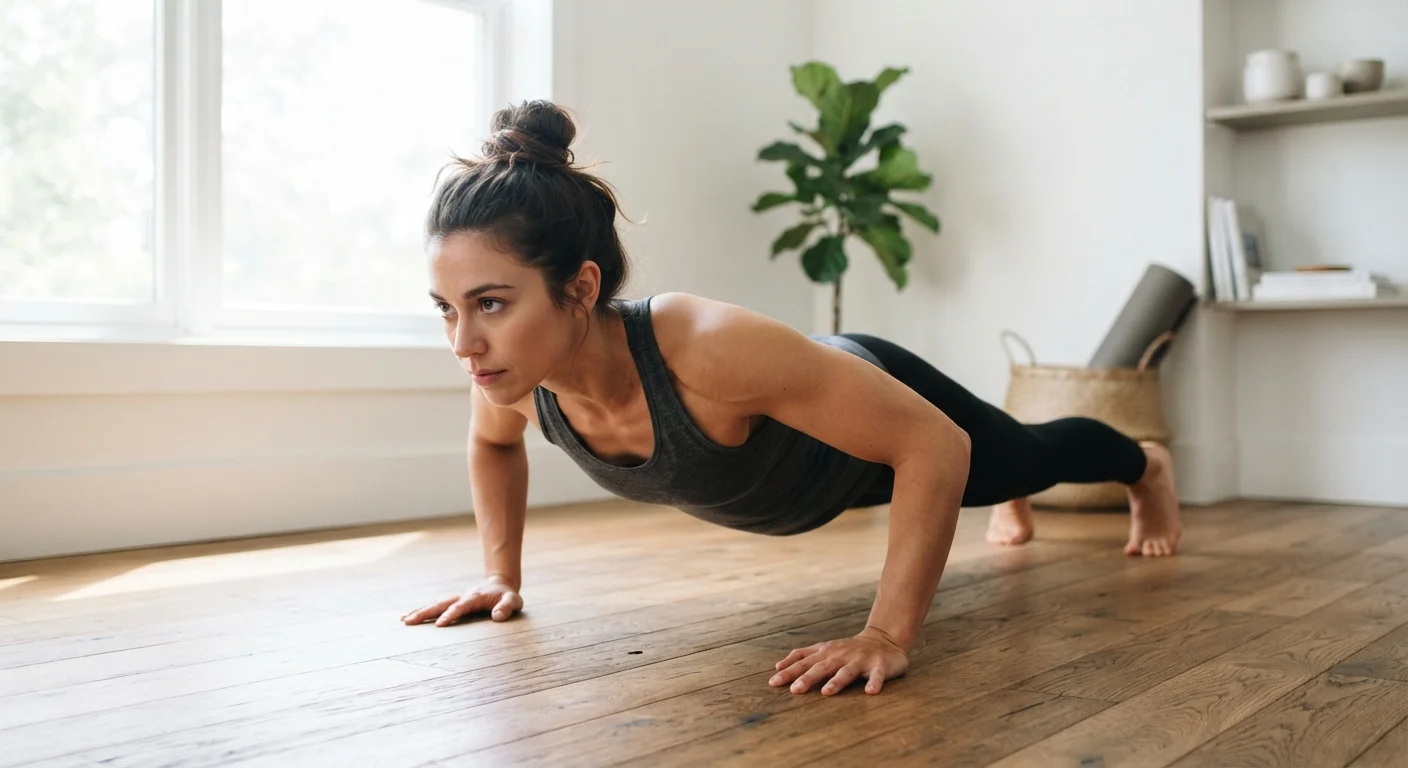
Key Takeaways
- Bodyweight training can build meaningful strength and muscle, especially for beginners and intermediate exercisers.
- Without added resistance, progress eventually plateaus for people seeking significant strength gains.
- Consistency and progressive overload matter as much in bodyweight training as in any other form of exercise.
- Bodyweight methods are well-suited for cardiovascular endurance, mobility, and body control.
- Advanced strength goals, particularly maximum muscle mass, generally require external load at some point.
No equipment or gym access needed
A floor, enough space to extend your limbs, and your own body are all that is required, making the barrier to starting extremely low.
Builds real strength for beginners and intermediates
Research on resistance training consistently shows that relative muscular effort, not absolute load, drives early strength adaptation, so well-structured bodyweight routines produce genuine gains.
Supports cardiovascular fitness through circuit formats
High-repetition or timed circuits raise heart rate into aerobic training zones, providing cardiovascular benefit alongside muscular work.
Develops functional movement quality
Many bodyweight movements require full-range control and balance, which builds the coordination and stability used in everyday activities.
Low injury risk when form is maintained
Without heavy external loads, the mechanical stress on joints and connective tissue is generally lower, which suits people returning from rest or managing mild physical limitations.
Limited progressive overload for advanced trainees
Once the body adapts to its own weight, meaningful strength progression requires increasingly complex movement variations that eventually reach a practical ceiling.
Maximum hypertrophy is difficult to reach
Significant muscle size gains, beyond a moderate level, typically require heavier and more varied external loads than bodyweight alone can provide.
Isolated muscle targeting is restricted
Bodyweight relies almost entirely on compound movements, limiting the ability to focus training on a single muscle group when rehabilitation or specific goals call for it.
Lower body strength gains can stall early
Body weight relative to leg muscle capacity means squats and lunges become insufficiently challenging for the lower body well before upper-body movements do.
Our Verdict
Bodyweight training is a legitimate, evidence-supported way to build strength, endurance, and movement quality, particularly for those new to exercise or working within real-world constraints like cost, space, or schedule. Its limits appear when advanced strength or maximum hypertrophy is the goal, since the body eventually adapts to its own weight as a fixed load.
Ideal for beginners, people returning after a break, those training at home, and anyone who wants a low-barrier, sustainable routine that builds real fitness without equipment.
What bodyweight training actually is
Bodyweight training uses the weight of your own body as the primary resistance. Push-ups, squats, lunges, pull-ups, dips, planks, and burpees are common examples. No barbell, no machine, no gym membership required. That simplicity is part of its appeal, but it also creates genuine constraints that are worth understanding before you commit to it as your main method.
It falls under resistance training because muscles must work against a load, even if that load is just you. For a fuller picture of how it compares to other exercise categories, see this overview of the major types of exercise.
What the evidence says about strength and muscle gains
For beginners, bodyweight exercises produce measurable strength and muscle gains. The nervous system and muscle tissue respond to relative effort, not absolute load, so a challenging push-up recruits muscle fibers in the chest, shoulders, and triceps in much the same way a bench press does at comparable intensity.
The challenge for more experienced exercisers is progressive overload. Building strength over time requires gradually increasing the demand on the muscle. With free weights or machines, you add a plate. With bodyweight, you shift to harder movement variations: standard push-up to archer push-up to one-arm push-up. That progression is possible but has a ceiling. Once you can perform a movement with excellent form and controlled tempo, further neurological and hypertrophic adaptation slows unless the mechanics change significantly.
No equipment or gym access needed
A floor, enough space to extend your limbs, and your own body are all that is required, making the barrier to starting extremely low.
Builds real strength for beginners and intermediates
Research on resistance training consistently shows that relative muscular effort, not absolute load, drives early strength adaptation, so well-structured bodyweight routines produce genuine gains.
Supports cardiovascular fitness through circuit formats
High-repetition or timed circuits raise heart rate into aerobic training zones, providing cardiovascular benefit alongside muscular work.
Develops functional movement quality
Many bodyweight movements require full-range control and balance, which builds the coordination and stability used in everyday activities.
Low injury risk when form is maintained
Without heavy external loads, the mechanical stress on joints and connective tissue is generally lower, which suits people returning from rest or managing mild physical limitations.
Limited progressive overload for advanced trainees
Once the body adapts to its own weight, meaningful strength progression requires increasingly complex movement variations that eventually reach a practical ceiling.
Maximum hypertrophy is difficult to reach
Significant muscle size gains, beyond a moderate level, typically require heavier and more varied external loads than bodyweight alone can provide.
Isolated muscle targeting is restricted
Bodyweight relies almost entirely on compound movements, limiting the ability to focus training on a single muscle group when rehabilitation or specific goals call for it.
Lower body strength gains can stall early
Body weight relative to leg muscle capacity means squats and lunges become insufficiently challenging for the lower body well before upper-body movements do.
Understanding how resistance training changes the body helps clarify why load progression matters beyond a certain baseline.
Endurance, mobility, and body control
Bodyweight training has a strong track record in areas that often get less attention than raw strength. Circuit-style formats, where exercises cycle with minimal rest, raise heart rate and improve cardiovascular conditioning in ways that parallel moderate-intensity cardio. Movements like the deep squat, hip hinge, and various plank progressions build the kind of functional stability that translates directly to daily movement and injury resilience.
Mobility and coordination also respond well to bodyweight practice, partly because many movements require balance and full-range control rather than being supported by a bench or machine. This is one area where bodyweight methods may outperform certain gym equipment for everyday movement quality.
~150 min
Weekly moderate activity recommended by major health guidelines
The U.S. Department of Health and Human Services Physical Activity Guidelines recommend at least 150 minutes of moderate-intensity aerobic activity per week for adults, a target bodyweight circuits can help meet.
2x/week
Minimum muscle-strengthening sessions advised for adults
The same federal guidelines advise muscle-strengthening activity on at least two days per week, and bodyweight resistance exercises qualify when performed at sufficient intensity.
The honest limits
The most consistent limitation is the difficulty of achieving maximum muscle hypertrophy, the kind associated with significant size gains, without eventually adding external resistance. At a certain point, the body adapts fully to its own weight as a load, and there is no practical bodyweight equivalent to progressively heavier barbells for exercises like the squat or deadlift pattern.
Isolated muscle work is another gap. Bodyweight training relies on compound movements, which is generally efficient, but someone recovering from an injury who needs targeted work on a single muscle group will find bodyweight options limited.
Bodyweight training and special populations
Older adults, people with osteoporosis, those managing cardiovascular conditions, and pregnant individuals all benefit from physical activity, but the appropriate type and intensity varies considerably. Bodyweight exercises are often recommended as a starting point for these groups, but specific guidance should come from a physician or qualified exercise professional familiar with the individual's health history.
Anyone managing a chronic condition, injury history, or significant physical limitation should consult a qualified healthcare professional before starting or intensifying any exercise program. General information here does not substitute for individual medical guidance.
Tracking progress when the scale tells you little
One common frustration with bodyweight training is not knowing whether progress is happening. Body composition changes slowly, and weight on a scale reflects hydration, food timing, and many other variables. More useful markers include how many quality repetitions you can complete, whether you can progress to a harder variation, how quickly your heart rate recovers after a circuit, and whether daily activities feel easier.
Practical ways to measure fitness progress beyond body weight covers these methods in detail. For those deciding between a home-based bodyweight routine and a gym setup, an honest comparison of home and gym training lays out the real trade-offs.
This article is for general informational purposes only and does not constitute medical or fitness advice. Consult a qualified healthcare or fitness professional for guidance suited to your individual circumstances.